
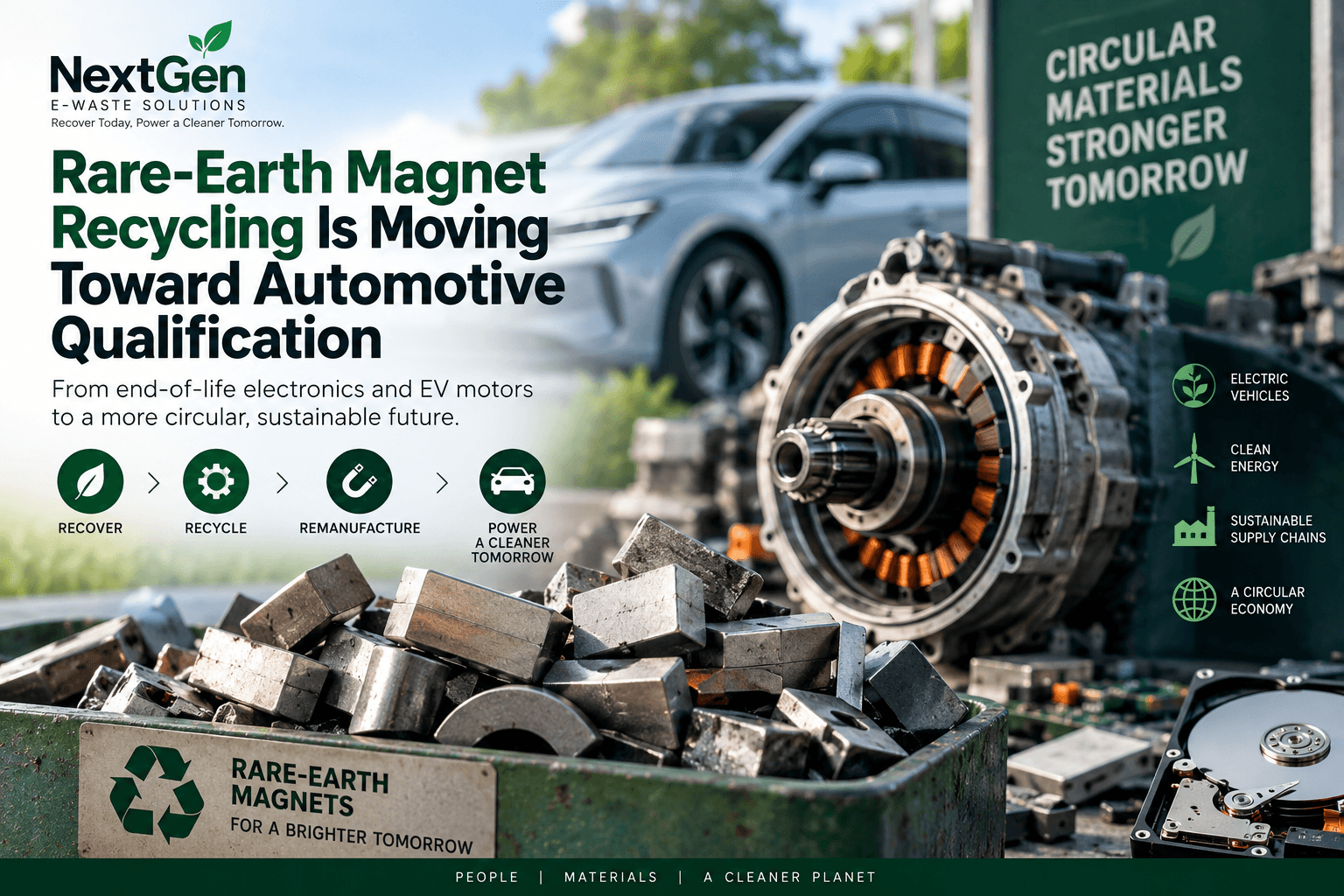
Rare-earth magnet recycling is moving into a more advanced stage.
For years, the discussion around neodymium-iron-boron (NdFeB) magnets was largely focused on how to recover valuable rare-earth materials from end-of-life products. The industry is now looking at a more demanding question:
Can recycled magnet material be processed into high-performance magnets suitable for demanding automotive applications?
That question is becoming increasingly important as electric vehicles, robotics, renewable energy systems and advanced electronics increase demand for high-performance permanent magnets.
In 2026, developments in the United Kingdom provide a strong example of this transition. The REACT-UK (Rare Earth Automotive Circular Technologies for the UK) project is a three-year, £6.5 million programme involving HyProMag, Mkango Rare Earths UK, EMR, Jaguar Land Rover, Less Common Metals and the University of Birmingham. Its objective is to recover magnets from end-of-life hybrid and electric vehicles and develop automotive-grade magnets from recycled material. :contentReference[oaicite:1]
India is also building a domestic rare-earth permanent magnet manufacturing ecosystem. The Government of India has approved a ₹7,280 crore scheme targeting 6,000 metric tonnes per annum (MTPA) of integrated sintered rare-earth permanent magnet manufacturing capacity. The programme is designed to strengthen domestic supply for sectors including electric mobility, renewable energy, electronics, aerospace and defence. :contentReference[oaicite:2]
Together, these developments point toward an important shift:
Rare-earth magnet scrap is increasingly being viewed as a strategic secondary material rather than simply another component of electronic or industrial waste.
1. What Are Rare-Earth Magnets?
Rare-earth permanent magnets are high-performance magnets that use rare-earth elements to achieve strong magnetic properties.
One of the most important types is the neodymium-iron-boron (NdFeB) magnet.
NdFeB magnets combine high magnetic strength with relatively compact size. This makes them useful in applications where manufacturers need high performance without adding excessive weight or volume.
They are used in a wide range of products and systems, including:
- Electric vehicle motors
- Hybrid vehicle motors
- Wind turbine generators
- Industrial motors
- Servo motors
- Robotics
- Hard disk drives
- Speakers
- Sensors and actuators
- Generators
- Medical equipment
- Consumer and industrial electronics
Rare-earth permanent magnets are particularly important in applications where compact size, magnetic strength and efficiency are important.
The Government of India also identifies electric vehicles, renewable energy, electronics, aerospace and defence among major applications for rare-earth permanent magnets. :contentReference[oaicite:3]
2. Why Rare-Earth Magnet Recycling Matters
Rare-earth elements are valuable materials, but recovering them from end-of-life products can be technically challenging.
If magnet-containing components are mixed into general scrap streams, their specific material value may be difficult to preserve.
Recycling creates another possibility:
End-of-life equipment
        ↓
Magnet-containing component
        ↓
Magnet identification
        ↓
Magnet recovery
        ↓
NdFeB material
        ↓
Reprocessing
        ↓
New magnet material
        ↓
New product
The objective is not simply to recover a piece of metal.
The longer-term goal is to keep valuable magnetic materials within the industrial supply chain.
This is particularly relevant for electric vehicles and other technologies that may create increasing demand for high-performance magnets.
3. Not All Magnets Are the Same
One of the most important points for scrap suppliers is that not every magnet is a rare-earth magnet.
A component can be magnetic without containing valuable rare-earth material.
Magnet-containing equipment may contain:
- NdFeB magnets
- Ferrite magnets
- Alnico magnets
- Other permanent magnetic materials
- Steel components that are attracted to magnets
Therefore:
Magnetic attraction alone does not prove that a component contains NdFeB.
For commercial scrap assessment, factors such as the original equipment, magnet design, dimensions, coating, grade and material composition can matter.
This distinction is important because NdFeB magnets and ordinary ferrous materials should not automatically be treated as the same scrap category.
4. Where Can NdFeB Magnets Be Found?
NdFeB magnets can occur in a variety of electronic, industrial and automotive products.
Potential sources include:
Hard Disk Drives
Certain hard disk drives contain strong NdFeB magnets in their actuator assemblies.
This makes HDD scrap a potential source of recoverable permanent magnets.
Electric Motors
Permanent-magnet motors can contain NdFeB magnets, depending on their motor design.
These may include:
- Servo motors
- Industrial motors
- Robotics motors
- Selected automotive motors
- Electric drive motors
Speakers
Some high-performance speakers use permanent magnets, although the magnet type varies between designs.
Generators
Certain generators use permanent magnets as part of their electromagnetic system.
Automotive Components
Electric and hybrid vehicle drive systems can contain rare-earth permanent magnets.
The exact quantity and grade depend on the motor design.
Industrial and Electronic Equipment
Automation systems, sensors, actuators and other specialized equipment can contain permanent magnets.
For scrap businesses, the important point is that source identification can be more useful than simply identifying something as "magnetic."
5. From Magnet Scrap to Magnet Recycling
There are several possible approaches to recycling rare-earth magnets.
Two broad pathways are particularly important.
Magnet-to-Magnet Recycling
In this approach, recovered magnet material is processed toward the manufacture of new magnets.
A simplified pathway looks like this:
End-of-life product
        ↓
Magnet recovery
        ↓
NdFeB material
        ↓
Processing
        ↓
Magnet manufacturing
        ↓
New NdFeB magnet
The attraction of this approach is that valuable magnet material can potentially remain within a relatively short industrial loop.
Element Recovery
Another approach is to chemically process magnet material to recover individual rare-earth elements.
A simplified pathway is:
End-of-life magnet
        ↓
Magnet recovery
        ↓
Chemical processing
        ↓
Rare-earth compounds
        ↓
Rare-earth metals
        ↓
Alloy production
        ↓
New magnets
Both approaches can contribute to a more resilient rare-earth supply chain.
The appropriate process depends on the feedstock, technology, economics and desired end product.
6. What Is Hydrogen Processing of Magnet Scrap?
One technology receiving significant attention is Hydrogen Processing of Magnet Scrap (HPMS).
HPMS was developed at the University of Birmingham and is commercially licensed to HyProMag.
The process uses hydrogen to help liberate NdFeB magnet material from suitable components and produce a demagnetised NdFeB alloy powder.
The University of Birmingham describes HPMS as part of the technology pathway being used within the REACT-UK project to recover NdFeB material from electric and hybrid vehicle drive motors. (University of Birmingham)
The broader concept is important because efficient separation is one of the major challenges in magnet recycling.
Instead of treating an entire motor or assembly as mixed material, the recycling process can be designed around recovering the magnet material specifically.
7. Why Automotive Qualification Is a Major Step
Recovering NdFeB material is only the beginning.
Automotive applications place demanding requirements on materials and components.
Electric drive motors can experience:
- High temperatures
- Mechanical stresses
- Electromagnetic stresses
- Repeated operating cycles
- Strict reliability requirements
A recycled magnet therefore needs more than simply high magnetic strength.
It must demonstrate appropriate:
- Magnetic performance
- Thermal performance
- Consistency
- Mechanical suitability
- Reliability
- Manufacturing repeatability
This is why the phrase automotive qualification is important.
The question is changing from:
"Can we recover rare-earth magnets from scrap?"
to:
"Can recycled rare-earth material be turned into magnets that meet the demanding requirements of automotive applications?"
That is a much higher technical and commercial threshold.
8. REACT-UK: Connecting Recycling With Automotive Manufacturing
The REACT-UK project is one of the clearest current examples of this transition.
The three-year, £6.5 million project brings together organisations from recycling, automotive manufacturing, materials processing and research.
The consortium includes:
- HyProMag
- Mkango Rare Earths UK
- EMR
- Jaguar Land Rover
- Less Common Metals
- University of Birmingham
The project aims to recover and recycle NdFeB magnets from end-of-life hybrid and electric vehicles and develop high-performance automotive magnet grades from recycled material. (University of Birmingham)
The planned supply chain connects several stages:
End-of-life hybrid / EV
            ↓
     Drive motor / rotor
            ↓
       Magnet recovery
            ↓
       NdFeB material
            ↓
   Recycling / processing
            ↓
     Alloy / powder feed
            ↓
    Magnet manufacturing
            ↓
 Automotive-grade NdFeB magnet
            ↓
      Automotive application
This is significant because it attempts to connect vehicle end-of-life recovery with new automotive magnet production.
It is not simply a recycling demonstration.
It is an attempt to build a circular industrial supply chain.
9. What Makes Automotive-Grade Magnets Different?
An automotive magnet may need to maintain its performance under demanding operating conditions.
One important property is coercivity.
Coercivity indicates how resistant a magnet is to losing its magnetisation when exposed to opposing magnetic fields or other stresses.
The University of Birmingham notes that grain boundary diffusion can be used to improve magnet coercivity, potentially enabling higher performance with less reliance on heavy rare-earth elements. (University of Birmingham)
This illustrates why automotive qualification is more complicated than simply measuring the amount of neodymium in a recycled material.
The final magnet needs to achieve the required performance characteristics.
10. From Testing to Qualification
It is important to distinguish three different stages:
Stage 1 — Material Recovery
Can useful NdFeB material be recovered from end-of-life equipment?
Stage 2 — Magnet Manufacturing and Testing
Can that recovered material be processed into a new magnet that performs as expected?
Stage 3 — Automotive Qualification
Can the resulting magnet meet the specifications, reliability requirements and validation processes required for automotive production?
These are not the same thing.
Progress at the first or second stage does not automatically mean that recycled magnets are already being used widely in mass-produced vehicles.
The significance of current projects is that they are helping move the technology toward the third stage.
11. EV Motors Could Become an Important Future Scrap Source
Electric vehicles could become an increasingly important source of end-of-life rare-earth magnet material.
Permanent-magnet electric drive motors can contain NdFeB magnets, depending on the motor architecture.
However, recovering those magnets efficiently is not straightforward.
Magnets can be embedded within motor assemblies and may require specialized dismantling or processing.
A simplified recovery chain could look like:
End-of-life EV
       ↓
Vehicle dismantling
       ↓
Drive unit recovery
       ↓
Motor / rotor processing
       ↓
Magnet recovery
       ↓
NdFeB material
       ↓
Recycling
The commercial success of this model will depend on several factors:
- Vehicle volumes
- Magnet content
- Dismantling costs
- Recovery efficiency
- Material quality
- Transportation
- Processing costs
- Market value of recovered material
Therefore, the value of future EV magnet recycling will depend on the entire supply chain, not just the value of the rare-earth elements.
12. India's Rare-Earth Magnet Manufacturing Push
India is also developing a domestic rare-earth permanent magnet manufacturing ecosystem.
The Government of India approved the Scheme to Promote Manufacturing of Sintered Rare Earth Permanent Magnets with a financial outlay of ₹7,280 crore.
The scheme aims to establish 6,000 MTPA of integrated manufacturing capacity.
The intended value chain covers stages from rare-earth oxides to metals, alloys and finished permanent magnets. (PM India)
The scheme is designed to strengthen supply chains for sectors including:
- Electric vehicles
- Renewable energy
- Electronics
- Aerospace
- Defence
- Industrial applications
The government says India's demand for rare-earth permanent magnets is currently met primarily through imports and that the initiative is intended to strengthen domestic manufacturing and reduce import dependence. (PM India)
The latest bidding status
The programme has progressed beyond the initial announcement.
According to a Ministry of Heavy Industries update reported by the Press Information Bureau, the technical bids were opened on 13 August 2026, following the 12 August bid deadline. The scheme targets five beneficiaries, with each beneficiary eligible for up to 1,200 MTPA of capacity. (Press Information Bureau)
This makes the Indian development particularly relevant to the future rare-earth magnet supply chain.
13. Why India's Manufacturing Push Matters for Recycling
Manufacturing and recycling can eventually become complementary parts of the same ecosystem.
A growing domestic magnet manufacturing industry requires reliable material inputs.
At the same time, increasing volumes of end-of-life electronic, industrial and automotive equipment can create secondary material streams.
A future circular ecosystem could look like:
Rare-earth raw materials
          +
Recycled magnet material
          ↓
   Magnet manufacturing
          ↓
 EV / industrial products
          ↓
    Product lifetime
          ↓
    End-of-life equipment
          ↓
     Magnet recovery
          ↓
   Recycled feedstock
          ↓
   Magnet manufacturing
This does not mean recycled material will immediately replace primary raw materials.
Instead, recycling can become an additional source of material as collection, processing and qualification technologies mature.
14. What Does This Mean for Magnet Scrap?
For businesses involved in electronic and industrial scrap, the development could change how magnet-containing material is viewed.
A component containing a rare-earth magnet may have more strategic value than its general scrap classification suggests.
However, not every magnet-containing item should automatically be classified as high-value NdFeB scrap.
Proper identification remains important.
Useful information can include:
- Equipment type
- Manufacturer
- Application
- Magnet location
- Magnet dimensions
- Quantity
- Approximate weight
- Material condition
- Source of the scrap
- Photographs
- Whether the magnets have already been removed
For larger industrial lots, keeping similar material together can also improve material assessment.
15. How Scrap Suppliers Can Prepare
Businesses holding magnet-containing equipment can take practical steps to improve material visibility.
Separate magnet-containing components
Where practical, keep identifiable magnet-containing components separate from general ferrous scrap.
Identify the source
Record whether material came from:
- HDDs
- Motors
- Industrial equipment
- Speakers
- Generators
- Automotive equipment
- Robotics
- Other electronic equipment
Avoid unnecessary mixing
Mixing different magnet types and grades can make downstream assessment more difficult.
Keep batches identifiable
If a large quantity comes from the same equipment type, keeping it together can provide useful information for buyers and processors.
Provide photographs
Photos of the original equipment and recovered magnets can help with preliminary material assessment.
Do not assume composition
A magnet's appearance or magnetic strength alone does not establish its exact composition.
Where material value is significant, proper technical identification may be required.
16. Challenges Facing Rare-Earth Magnet Recycling
Despite the progress, several challenges remain.
1. Collection
Suitable magnet-containing scrap must be collected in sufficient quantities.
2. Dismantling
Magnets can be difficult to access within complex products and assemblies.
3. Material variation
Magnets from different products can have different compositions, grades, coatings and performance characteristics.
4. Processing cost
Collection, transportation, dismantling, separation and processing all contribute to the economics.
5. Feedstock quality
Recycling processes need suitable and sufficiently consistent material streams.
6. Manufacturing quality
Recovered material must be capable of producing magnets with predictable properties.
7. Automotive validation
Automotive applications require extensive testing and qualification.
8. Supply-chain scale
Recycling becomes more commercially attractive when collection and processing volumes are large enough to support efficient operations.
These challenges explain why the transition from laboratory technology to commercial automotive supply chains takes time.
17. The Strategic Value of Magnet Scrap
Rare-earth magnets are increasingly connected to strategic industries.
They are relevant to:
- Electric mobility
- Renewable energy
- Advanced manufacturing
- Robotics
- Electronics
- Aerospace
- Defence
This means magnet recycling is not simply a waste-management issue.
It is also a materials and supply-chain issue.
Recovering magnets from end-of-life products can potentially create a domestic secondary source of material.
For countries seeking greater supply-chain resilience, that secondary source can become increasingly important.
18. What Businesses Should Watch Next
The next stage of the industry will be shaped by how successfully recycling technologies move from development and demonstration toward repeatable commercial operations.
Businesses involved in electronic scrap, industrial equipment and automotive end-of-life management should watch:
- Automotive qualification of recycled NdFeB magnets
- EV motor magnet recovery
- Magnet-to-magnet recycling
- Rare-earth element recovery
- Domestic magnet manufacturing
- Development of recycling facilities
- Demand for recycled magnet feedstock
- Material traceability
- Magnet identification technologies
- Automotive supply-chain adoption
The important change is that rare-earth magnets are increasingly being considered recoverable strategic materials.
19. What This Could Mean for the Scrap Industry
The scrap industry has historically focused heavily on traditional material categories such as:
- Ferrous metals
- Aluminium
- Copper
- Brass
- Stainless steel
- Electronic scrap
Rare-earth magnet recycling adds another layer of material identification.
Instead of treating a motor, hard drive or electronic assembly only according to its bulk metal content, businesses can increasingly look at the valuable components contained inside it.
This is particularly relevant to component-level recovery.
A single piece of equipment may contain:
Steel
+
Aluminium
+
Copper
+
PCB
+
Electronic components
+
Rare-earth magnet
Separating these material streams can potentially create more value than processing the entire item as mixed scrap.
This is one reason why better sorting and material identification will become increasingly important.
20. The Road Ahead
Rare-earth magnet recycling is moving toward a more sophisticated industrial model.
The objective is no longer limited to recovering rare-earth-containing material from waste.
The larger ambition is to create a circular supply chain in which magnets from end-of-life products can become feedstock for new high-performance magnets.
Projects such as REACT-UK demonstrate how automotive manufacturers, recyclers, materials companies and research institutions are attempting to connect these stages. (University of Birmingham)
India's development of a 6,000 MTPA integrated REPM manufacturing ecosystem adds another important dimension to the global picture. (PM India)
The transition will not happen overnight.
Automotive qualification requires rigorous validation, while commercial recycling requires sufficient feedstock, efficient processing and competitive economics.
But the direction is becoming clearer:
The future of rare-earth magnet recycling is not simply about recovering magnets from waste. It is about creating reliable secondary material streams capable of supporting the next generation of high-performance manufacturing.
What Businesses Can Do Today
If your company has obsolete electronic equipment, industrial motors, hard disk drives, speakers, generators, automation equipment or other magnet-containing materials, proper identification and segregation can help preserve the value of recoverable components.
At NextGen E-Waste Solutions, we procure industrial electronic scrap, IT assets, PCB boards, batteries, copper scrap, magnet-containing materials and other electronic materials in bulk.
Where equipment has reuse value, it can be considered for refurbishment or resale. Materials that are not suitable for reuse are channelized through appropriate downstream recycling and recovery partners.
If your business has bulk electronic or industrial scrap containing potential magnet materials, our team can assess the material and discuss procurement requirements.
NextGen E-Waste Solutions
Industrial E-Waste Procurement & Asset Recovery
Pimpri-Chinchwad, Maharashtra
PAN India Procurement & Pickup
Key Takeaways
- NdFeB magnets are important components in many high-performance applications, including selected electric vehicle motors.
- Rare-earth magnet recycling is moving beyond simple material recovery toward magnet-to-magnet recycling.
- Automotive applications require significantly higher levels of testing and qualification than ordinary material recovery.
- The REACT-UK project is developing a circular supply chain for automotive NdFeB magnets recovered from end-of-life hybrid and electric vehicles. (University of Birmingham)
- India's ₹7,280 crore REPM scheme targets 6,000 MTPA of integrated rare-earth permanent magnet manufacturing capacity. (PM India)
- Not every magnet is a rare-earth magnet; NdFeB, ferrite and other magnetic materials must be distinguished.
- Proper identification and segregation of magnet-containing scrap can become increasingly important as recycling markets develop.
- Automotive qualification, processing economics, collection and supply-chain scale remain important challenges.
Rare-earth magnet recycling is moving from recovery toward qualification — and that could make magnet-containing electronic, industrial and automotive scrap increasingly important to the circular materials economy.
Sources
- University of Birmingham — REACT-UK: Fully circular UK supply chain for rare-earth magnets with high-grade automotive applications.
- HyProMag — REACT-UK project and automotive rare-earth magnet recycling.
- University of Birmingham — Rare-earth magnet recycling facility and hydrogen-based processing.
- Government of India / Prime Minister's Office — Scheme to Promote Manufacturing of Sintered Rare Earth Permanent Magnets.
- Ministry of Heavy Industries / Press Information Bureau — 6,000 MTPA REPM manufacturing scheme and 2026 bidding status.
- International Energy Agency — India Scheme to Promote Manufacturing of Sintered Rare Earth Permanent Magnet.